


U.S.Europe Greenland Dispute 2026: Trump Diplomacy and Arctic Tensions Explained.
Early in 2026, a huge ice-covered region in the North Atlantic was at the centre of an international diplomatic crisis. The beautiful glaciers and low population of Greenland were suddenly drawn in the middle of a hot U.S.-Europe conflict. What began as a course of audacious ideas of President Donald Trump turned out to be a crisis that challenged the very foundations of the Western alliance. It was the sovereignty, security and the future of the Arctic that dominated headlines. The notion of a superpower, eager to obtain a huge island, might be considered historical, but it was a practicality which was prompted by the earthly policy. It was only when the World Economic Forum in Davos took a dramatic twist that de-escalation of the situation became possible.
Greenland Dispute 2026 background: U.S.-Europe Relations.
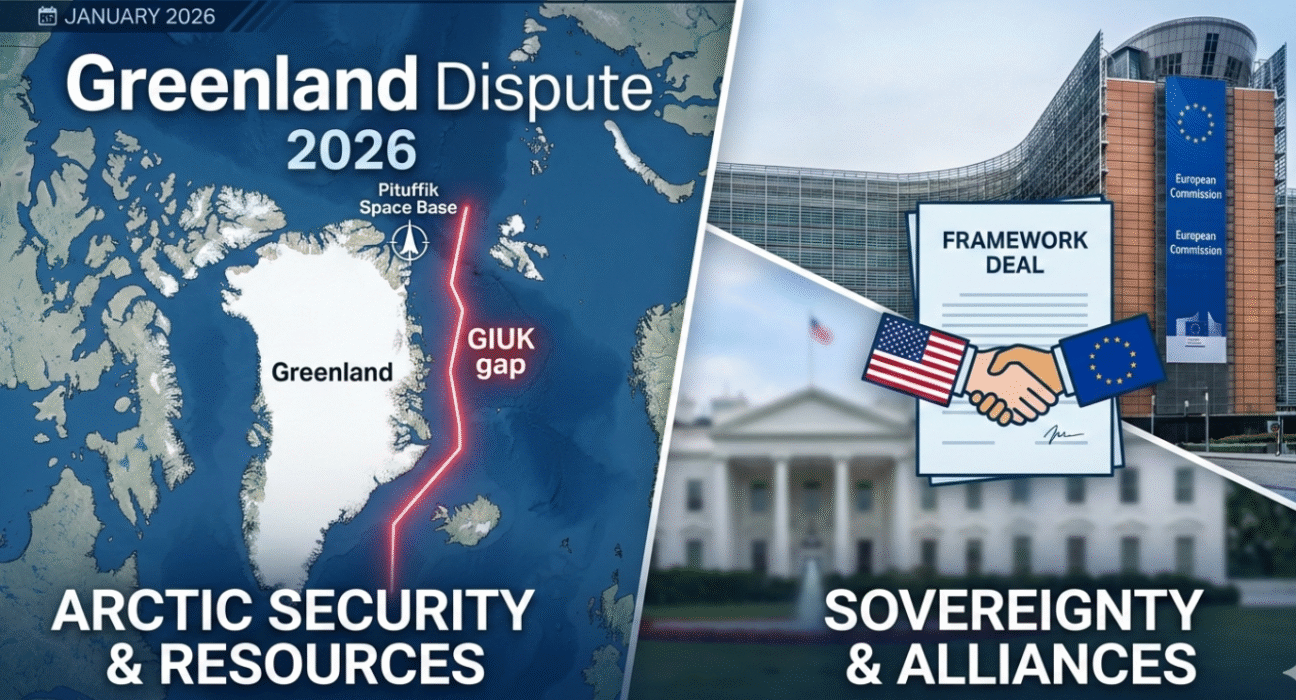
Greenland is an autonomous, self-governing part of the Kingdom of Denmark. Although it does not interfere with its domestic affairs, foreign policy and security is under Copenhagen. It has been a silent yet critical support of North American defense over decades. The U.S. has been using the Pituffik Space Base (previously Thule Air Base) there, which was important in the 1950s as a missile warning and satellite surveillance base.
Climate change has increased the strategic value of the island in the recent past. Arctic ice is melting, new shipping routes will be available, and large reserves of valuable minerals, necessary to drive technology and green energy, will be more accessible. This has rendered Greenland a geopolitical prize. The U.S fears that unless it consolidates its presence, its competitors like Russia and China may increase their control in the region.
The Latest U.S. moves on Greenland: Trump Diplomacy.
On his 2024 re-election, President Trump renewed his interest in Greenland. His style, usually referred to as Trump diplomacy, was based on leverage on high stakes and pressure. At the beginning of January 2026, the rhetoric was more than intense. The President proposed that the U.S. could acquire Greenland one way or the other and even proposed imposing huge tariffs to the European powers resisting the action.
The tension was at its peak when the White House decided to issue a 10 per cent tariff on what the White House planned to raise to 25 per cent of goods that were of Denmark and other allies. On January 21, 2026, a breakthrough was made. Trump declared a framework of a future deal after a meeting of the pivotal one with the NATO Secretary General Mark Rutte in Davos. His support of tariff threats and the elimination of the use of force faded and an emphasis on getting the island as a source of defense and mineral exploration became more of a priority.
NATO Relations, Europe and Greenland Dispute.
The response of Europe was very strong with a sense of guarded relief. Danish Prime Minister Mette Frederiksen made it very clear that, “Greenland is not on sale, and any action that could threaten the sovereignty of any member of the NATO would be a potential threat to the alliance. This was echoed by other European leaders and officials of NATO who noted that alliances are not made by coercion but through cooperation.
The conflict had the short-term effect of splitting NATO with some member states sending military reinforcements to Greenland in support of Denmark. The deal with the framework was perceived as a diplomatic victory, but leaders of Europe are now cautious. They demand that it should consider Danish sovereignty and the rights of the people of Greenland, and this casts doubts on the long-term relations between the United States and Europe under the transactional diplomacy.
Greenland Dispute and its Implication on Arctic Security.
The Greenland controversy reveals the increased interest in the issue of Arctic security. The Arctic is no more a far off place but also a battlefield of international rivalry. Having obtained access architecture, the U.S. intends to raise its Golden Dome missile shooter network and avoid Russian or Chinese naval superiority in the Greenland-Iceland-UK (GIUK) chasm.
This conflict is a precedent in global negotiations of the 21st century in that the negotiations are not based on the traditional treaties but rather on the interests. The tension also stands a chance of tearing the U.S and allies which gives its enemies room to play upon the differences among the Western alliance.
Media and public response to the U.S-Europe greenland dispute.
The responses of media and social media were of amazement, doubt, and concern. On X (previously Twitter), the hashtag became a trend over days, as it was debated whether the actions of President Trump were clever manipulation or a threat to diplomatic standards. Memes representing Greenland as a tower containing a Trump Tower spread alongside the opinions of political scientists that there would be repercussions to the post-war world order.
The interest of people rose as they sought Greenland history and status in the law. To most of them, the conflict was the initial step into understanding the strategic significance of the so-called High North, and the debates were frequently divided along the lines of nationalism and internationalism, where the interests of American security needs were opposed to the sovereignty of smaller states.
The reasons why people are looking into the Greenland Dispute 2026.
People were interested in the fact that it was a high profile territorial dispute between two long-term allies. Citizens demanded elucidation regarding the sole amalgamation between economic, military, and person-oriented politics in operation. The political thriller aspect was enhanced by the tariff threats towards the friends and the strategic enigma of the Arctic, which provoked the extensive online search and interest.
Conclusion
The Greenland conflict of 2026 shows how the relations between the US and Europe will change very fast. Although the tense situation was reduced with the help of the so-called framework deal, there is still latent competition between the strategies. The episode highlights the increasing worth of the Arctic, the aggressive aspect of the Trumpian diplomacy, and the strength of European sovereignty.
International observers will be on the lookout with the negotiation going on. The Greenland dispute is the case that anyone concerned with NATO, the Arctic security, and the balance of power in an evolving geopolitical environment has to know. The driving forces that are still in place to date to shape our modern world are sovereignty, alliances and strategic interests.