

Global Markets & Davos Impacts: How 2026 Developments Are Shaping Investor Sentiment
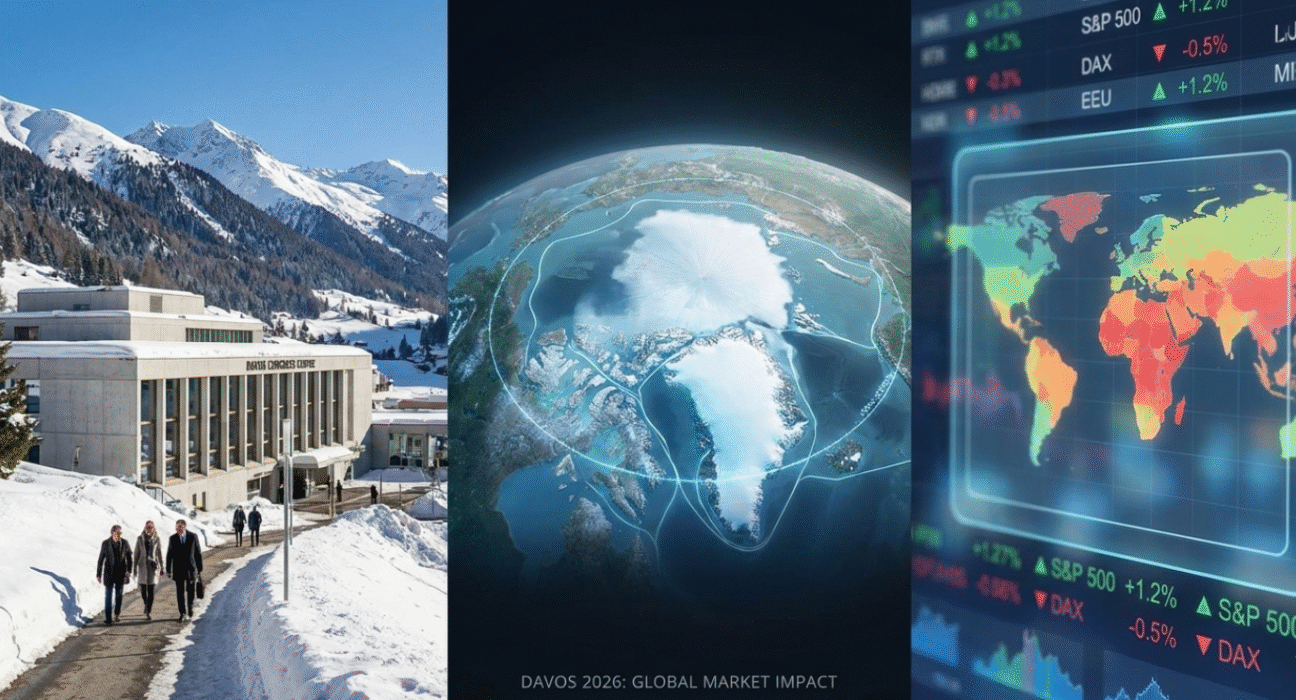
The contemporary global markets are very sensitive to political activities, diplomacy and high level summits. The World Economic Forum in Davos is closely monitored by investors and analysts alike as world leaders, business people and policy makers convene in the town to deliberate on the future of the world economy. In particular, the Davos summit has attracted significant interest in 2026 because of geopolitical strains, trade talks, and the recent Greenland dispute, which have all contributed to investor feeling and the market action.
Key Events at Davos 2026
The 2026 Davos summit hosted leaders of nations globally to deliberate on such crucial matters as economic progress, commercial strategies, energy shifts, and worldwide collaboration. Words of world leaders, presidents and representatives of companies reverberated in the financial markets. The supply chain resilience discussions, inflation issues and possible regulatory changes grabbed the attention of investors. The Greenland conflict and the aggressive US foreign policy were another source of sensitivity in the market at the summit.
Greenland Dispute/ Trump Diplomacy: Impact on Global Markets.
Market stability is usually influenced by political tensions, and the Greenland issue was an excellent case in point. The rhetoric and perceived threat of tariffs toward European allies made by President Donald Trump caused a temporary spike. The reaction of the European and U.S. markets was rather cautious and as a result, the key indexes of the stock markets fluctuated. The further diplomatic development at Davos that involved informing about access to the defense and resource deals served to soothe the initial panic and resulted in a partial recovery of the markets.
Europe and the U.S. Investor Reactions.
European and U.S. investors reacted differently to the events that were unfolding. In America, such indices as S&P 500, Dow Jones and Nasdaq were slightly dipping at the peak of the Greenland dispute but soon recovered when the news of the diplomatic agreements surfaced. European markets, such as the DAX, FTSE 100, as well as the Stoxx 600 stock markets, were either a cocktail of relief and cautious optimism. Analysts pointed out that even among allies, geopolitical uncertainty can have a temporary effect on investor confidence, but it will stabilize as soon as agreements are achieved.
Sector-Specific Impacts
Some of these sectors were more delicate to such developments. Greenland and Arctic security talks had a strategic significance on defense and aerospace stocks. There were also changes in energy and technology fields because of trade strains and negotiations on resource availability. The stocks related to tourism and travel were under close watch because political uncertainty has the potential of influencing consumer sentiment and global mobility.
Economic Implications of a Global Scale.
Davos 2026 summit has highlighted that the world economic trends are becoming more and more integrated with geopolitical events. Trade policies, alliances, and Arctic security are decisions that have an effect on the mood of the investors across the globe. Political transparency (or lack of it) affects supply chain policies, global relationships and market risk analysis. The Greenland conflict presented the power of a seemingly distant territory to play a disproportionately significant role in international markets.
Media and Public Reaction
The Greenland situation and Davos results were the news that attracted the whole world in news media and social media. It was financial outlets where the stock responses were studied, and social media were trending with discussions around Trump diplomacy, alliances, and stock volatility. These stories were read with a close eye by many retail investors who wanted to know how political choices will impact their own investments as well as the rest of the world trade.
The Reason People are Searching on this Topic.
The worldwide market and Davos searches have gone beyond the roof since investors, students and the common people are keen to know how diplomacy and international summits are defining the economic trends. This strange combination of political drama, market turbulence, and high profile summit negotiations makes this an interesting story to viewers who desire to follow both investment and global economic risks.
Conclusion
The Davos summit of 2026 and other geo-political power events such as the Greenland conflict and Trump diplomacy have shown the close relationship between politics and the global market. The mood of investors is delicate towards top-level diplomacy as well as territorial conflicts. To retail investors and mood surveyers, it is of greater essence to be aware of such incidences so as to be at a position to observe trends, risk management and make informed decisions in a world that is more interconnected.
Economics no longer prevails in the global market, as it is a dynamically responding market to diplomacy, strategy, and international bargains. Davos 2026 has reminded the world once again that political events are not merely news items but they are moving forces that are influencing investor confidence, and financial results.